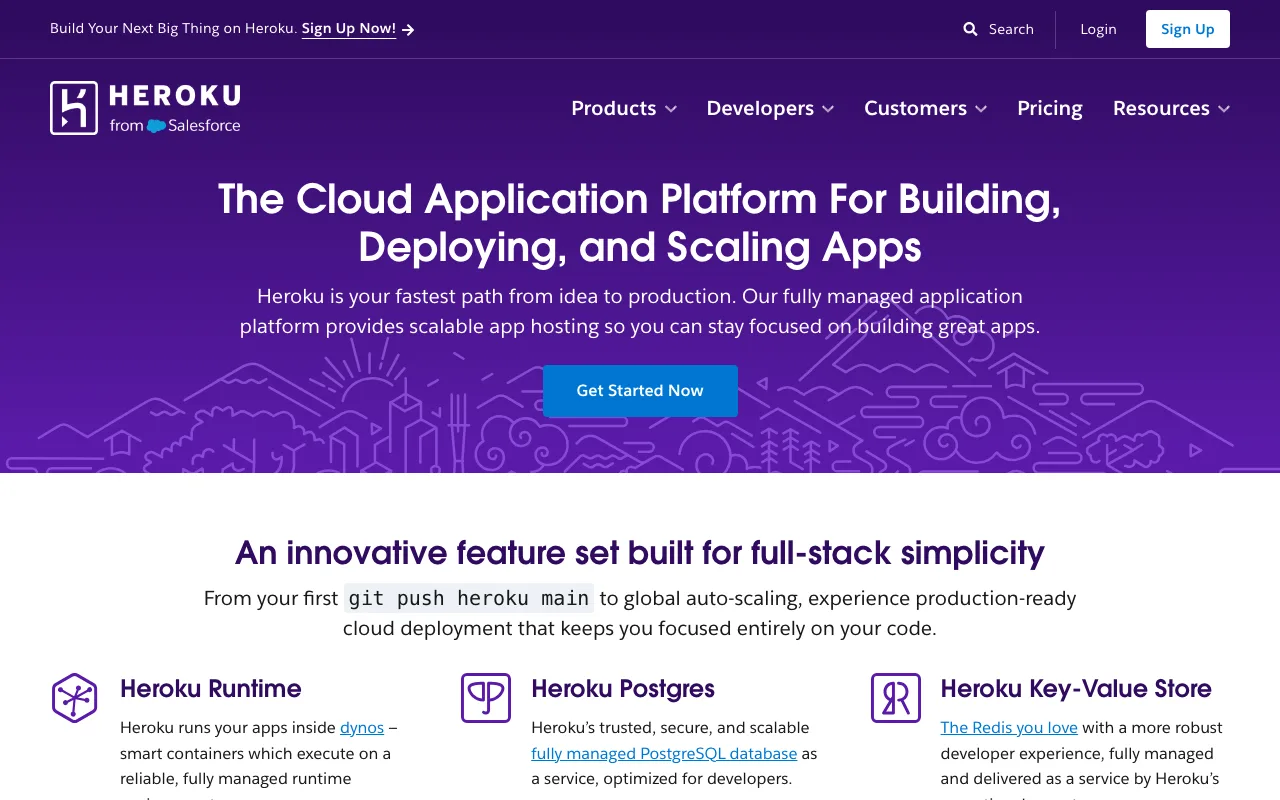
Heroku Review
Heroku invented this category and still runs apps with grace, but a decade of Salesforce stewardship, the 2022 free-tier massacre and prices frozen in 2015 make it hard to recommend to anyone starting fresh.
Review last updated 2026-08-20 · How we rate hosts
Scorecard
Pros
- The original PaaS: buildpacks, Procfiles and git push heroku main started here
- Deep, mature add-on marketplace and managed Postgres lineage
- Rock-solid, boring stability under Salesforce ownership
- Pipelines, review apps and CI integration remain genuinely good
Cons
- Dreadful price-to-resources ratio: $25/mo still buys a 512 MB dyno
- Free tier removed in 2022, taking most of the community with it
- Innovation has visibly slowed; the platform feels maintained, not advanced
- US and EU regions only unless you pay for Private Spaces
Heroku plans & pricing
Promotional monthly rates as of August 20, 2026; most require the listed prepaid term and renew at the higher rate shown. Confirm on Heroku's site before buying.
| Plan | Intro price | Renews at | Storage | Sites | Bandwidth | Notes |
|---|---|---|---|---|---|---|
| EcoApp Platforms | $5/mo | $5/mo | $5/mo buys a shared pool of 1,000 dyno hours across all Eco apps; dynos sleep after 30 minutes of inactivity | |||
| BasicApp Platforms | $7/mo | $7/mo | Always-on dyno for one app; Postgres costs extra (Essential-0 from $5/mo) | |||
| Standard-1XApp Platforms | $25/mo | $25/mo | Adds autoscaling-ready metrics, preboot and unlimited app metrics; still 512 MB RAM | |||
| Performance-MApp Platforms | $250/mo | $250/mo | Dedicated compute; Performance-L at $500/mo has 14 GB RAM |
Our Heroku review
Heroku is where platform-as-a-service was born. git push heroku main, buildpacks, Procfiles, the twelve-factor app manifesto: the entire vocabulary of this category came out of Heroku between 2007 and 2013. That legacy is why it still appears on every shortlist, and why its slow fade matters.
The turning point was November 2022, when Salesforce eliminated the free tier that had onboarded a generation of developers. Hundreds of thousands of hobby apps, student projects and tutorials died overnight, and the goodwill loss was enormous. The Eco plan ($5 a month for 1,000 shared dyno hours, with sleeping apps) was the replacement, but the community had already scattered to Render, Railway and Fly, taking blog posts, tutorials and mindshare with them.
The deeper problem is value. Heroku's $25 Standard-1X dyno still ships 512 MB of RAM, a spec that was thin in 2015 and is indefensible in 2026 when Render sells 2 GB for the same money and a Hetzner VPS offers 8 GB for a third of it. Postgres, Redis-style key value storage and every add-on bill separately, so a modest production app quickly lands north of $50 a month for resources competitors sell for $15.
What you still get for the premium is maturity. Deploys, pipelines, review apps and rollbacks work with a decade-polished smoothness. The add-on marketplace remains the deepest in the industry. Uptime is boringly good, and for teams in the Salesforce orbit the integrations are convenient. Heroku has also added modern touches, including a managed AI inference service, but nobody would describe the platform's recent pace as ambitious.
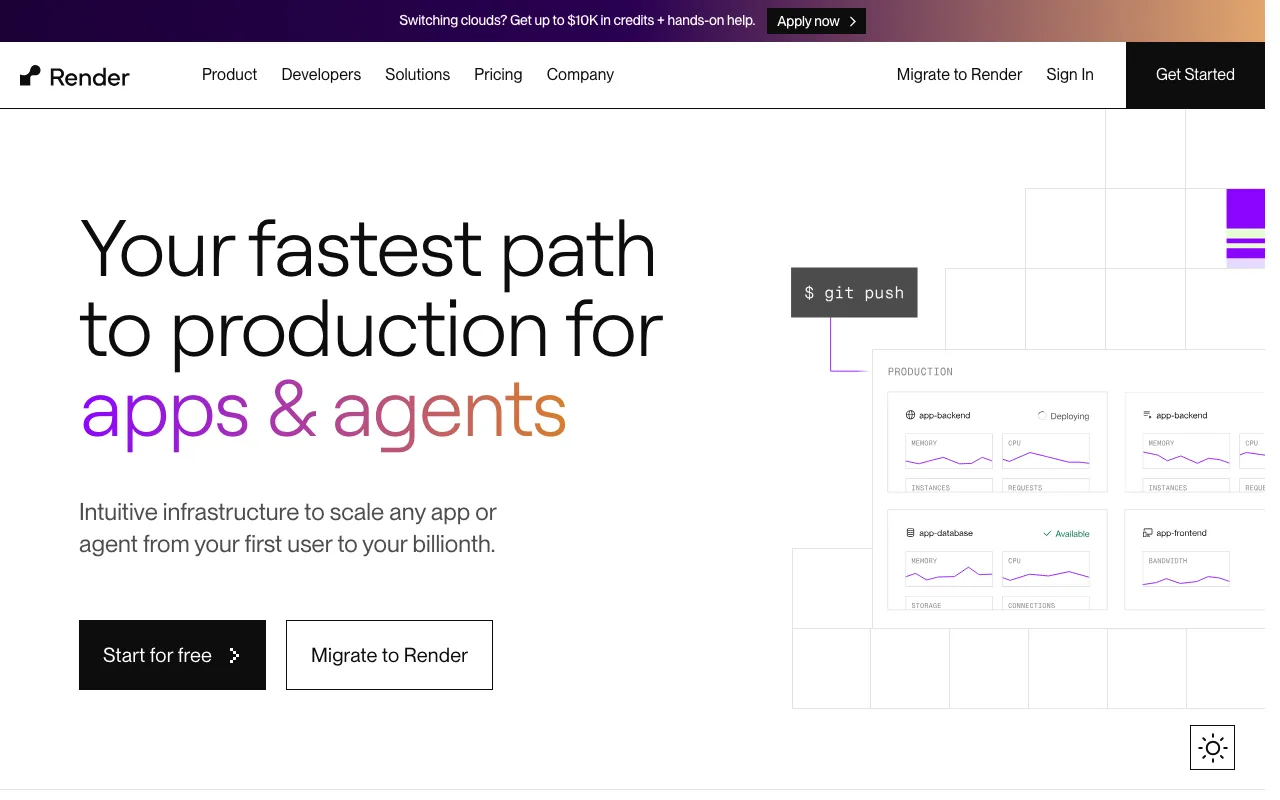
Verdict: existing Heroku shops with working pipelines have little urgent reason to leave; migration costs are real and the platform is stable. But for new projects the equation rarely favors it. Render offers the same mental model at half the effective cost, and that comparison is the one Heroku keeps losing.
Notable facts
- Invented the modern PaaS model and the twelve-factor app methodology
- Acquired by Salesforce in 2010 for $212 million
- Eliminated its famous free tier in November 2022
At a glance
| Founded | 2007 |
|---|---|
| Headquarters | San Francisco, California, US (Salesforce) |
| Data centers | US and EU common runtime; more regions via Private Spaces |
| Hosting types | App Platforms |
| Starting price | $5/mo |
| Support | tickets, knowledge-base |
| Free migration | No |
Frequently asked questions
Is there still a free Heroku plan?
No. The free tier ended in November 2022. The cheapest option is Eco at $5/mo, which provides 1,000 dyno hours shared across your apps, and Eco dynos sleep after 30 minutes of inactivity.
What should I use instead of Heroku?
Render is the closest one-to-one replacement for the git-push workflow at better prices. Railway suits fast-moving small projects, and Fly.io fits apps that need multi-region deployment. Heroku itself still makes sense if your team already runs on it.
Bottom line
Heroku invented this category and still runs apps with grace, but a decade of Salesforce stewardship, the 2022 free-tier massacre and prices frozen in 2015 make it hard to recommend to anyone starting fresh.
Check current Heroku pricing →